Monday, October 7, 2013

The Action and Mystery Deepen in Theatre [502]’s Serial Play

Scott Anthony, Douglas Scott Sorensen, Alexandra Sweatt &
Becca Willenbrink in The Stranger and Ludlow Quinn. Photo – Theatre [502].

The Stranger and Ludlow Quinn, Chapter Five: All Soul’s Day

Written by Diana Grisanti and Steve Moulds
Directed by Amy Attaway

Review by Keith Waits

Entire contents copyright 2013 by Keith Waits. All rights reserved.

Did the book explode? Is Murray dead? How much of it is all a dream? In chapter five of The Stranger and Ludlow Quinn, the story takes important steps into deeper waters narratively and emotionally. As earlier chapters relied on ingenuity and sharp wit to engage the audience, the middle entries are pulling us in to a more tangible relationship with the action, most particularly by focusing on Bonnie Burke and developing her character with meaning.

At the same time, the mystery deepens, as the exact events that occur in the aftermath of Bonnie’s visit to Murray’s Magic Shop are left unclear, communicated as they are here, in and out of the hazy fog of dreams. The surreal tone is new but potently portrayed and takes us inside Bonnie’s state of mind, confirming beyond a doubt that this is, more than anything else, her story.

So this chapter belongs to Becca Willenbrink, who has faithfully occupied Bonnie as a fairly passive onlooker but now is given the opportunity to explore the character more fully. Her sensitive performance is one payoff for the patient dedication to a play that is just now approaching the midway point. Not that forbearance is required, but Stranger needed to move in this direction; and that it does so now is further testament to the care given to structure and continuity in this high-wire act. Things feel right on schedule.
  
New chapters are scheduled to arrive on First Fridays each month through April 2014, performed at 7 p.m., 8 p.m., 9 p.m., and 10 p.m. Admission is free, but donations are welcome.
The Stranger and Ludlow Quinn, Chapter Five: All Soul’s Day
October 4, 2013
Theatre [502]
at The Baron's Theatre

131 West Main Street
Louisville, KY 40202
Theatre502.org


Classic Thriller at Derby Dinner Playhouse Might Make You Jump Out of Your Seat

Brian Bowman as Clifford and David Myers as Sidney
in Deathtrap. Photo – Derby Dinner Playhouse.


Deathtrap

Written by Ira Levin
Directed by Bekki Jo Schneider

Reviewed by Keith Waits

Entire contents are copyright © 2013, Keith Waits. All rights reserved.

Ira Levin’s Deathtrap holds the record for being the longest-running comedy-thriller in Broadway history, and the chief reason is a scenario that manages to be both tricky and economical. The mix of macabre humor, surprise plot twists and grisly, scary moments make for a fairly irresistible treat for an audience. It also means that the less said about the plot the better, so we will leave it at this: Sidney Bruhl, a highly successful writer of mystery plays, experiences a serious writer’s block that is only exacerbated by a new script from a young man named Clifford, who had attended one of Sidney’s seminars. Sidney’s wife, Myra, is horrified when Sidney seems to begin contemplating the possibility of killing off Clifford and stealing his brilliant new play to claim as his own.

That Clifford’s play is also called Deathtrap and is repeatedly described as “a one set, five character thriller” is a knowing wink and a nod to the audience that the action is operating on two levels: the straightforward thriller story; and ironic, self-referential commentary on the genre itself.

Derby Dinner’s production delivers the company’s customary excellence in production design and technical execution. There are some very specific staging requirements that make this one of the few instances where an “in-the-round” configuration must be abandoned, but it is the right, perhaps only, choice, and Ron Riall’s set fits the bill and then some. A very effective sound design and musical underscore is employed to emphasize the cinematic nature of the story.

I cannot help but feel that David Myers was somewhat miscast as Sidney. The Derby Dinner veteran brings his straightforward, robust manner to a role that requires both deviousness and a more subtle touch than is managed in this performance. Brian Bowman fares slightly better as Clifford, capturing the disingenuousness of the character; while Tina Jo Wallace does as well as she might by the underwritten Myra. Two other characters who appear – a psychic neighbor named Helga Ten Dorp (Elizabeth Loos) and Sidney’s lawyer, Porter Milgram (J.R. Stuart) – are delivered in appropriate measure. Ms. Loos is perhaps a little over-the-top as Helga, but the character is unquestionably defined by the author in very broad comic terms; while Mr. Stuart was a pleasant and well-timed presence in a role that is primarily plot device except for one bright comic scene with Helga.

Deathtrap ultimately seems a little old-fashioned, which is not necessarily a bad thing. It’s an example of a kind of entertainment that is rarely seen, a real “they don’t make 'em like that anymore” experience. As expertly staged as it is here, it still comes off as more quaint than thrilling. Opening night, the thrills played more strongly than the comedy; and if you have never seen it, there are a couple of jump-out-of-your-seat moments that work beautifully.

Deathtrap

October 1- November 10, 2013

Derby Dinner Playhouse
525 Marriott Drive
Clarksville, IN 47129
Tickets (812) 288-8281


Friday, October 4, 2013

Interview with Puppeteer/Actors in Broadway Across America's "War Horse"

Jude Sandy (Head); Isaac Woofter (Heart); Lute Breuer (Hind).
Photo by Frankie Steele.

Interview by Scott Dowd. Entire contents copyright ©Fearless Designs, Inc. All rights reserved.


Last month subscribers to PNC Broadway in Louisville were invited to a special presentation at the Bomhard Theater. About five hundred people turned out that evening to meet Joey, the star of the Broadway sensation War Horse. Joey, in case you are not yet familiar with the characters in Michael Morpurgo’s novel, is a horse. Not a human character in the form of a horse – a real, live, breathing horse. Steven Spielburg’s screen adaptation features an actual member of the species Equus ferus caballus. The creative team behind the stage version, however, had to be a little more creative. Directors Marianne Elliott and Tom Morris worked with South African puppet designers Basil Jones and Adrian Kohler of Handspring Puppet Company to create Joey, Topthorn and the other puppets that star in the Tony Award-winning production of War Horse. But wonderful puppets and an engaging story still were not enough. The team turned to choreographer Toby Sedgwick to develop the movements that would allow audiences to willingly suspend their disbelief and accept Joey as a living member of the cast. Sedgwick drew heavily from the traditional Japanese puppet form bunraku and Thai puppet theatre to train the three-person teams responsible for actualizing the characters of Joey and Topthorn. Following their presentation, I sat down with the team that includes puppeteer/actors Jude Sandy, Isaac Woofter and Lute Breuer to lift the veil a bit on the techniques they use to give Joey life. They began by telling me about the physical and emotional tasks assigned to each member of a given team.

JS:  I am the “Head” puppeteer. I express Joey through the height of the head and relationship to the shoulders to show the level of alertness, or fear, or comfort, or exhaustion. I am responsible for the eyes. People think that the eyes are moving, but they are set, and it really is about subtle head movements that make the eyes live. I also control the position of the ears, which are very indicative of mood. 

SD:  What prepared you to take on this role?
JS:  I began studying dance and moved quickly into theatre. I’m originally from Trinidad, but at the age of twenty-five I enrolled in the Resumed Undergraduate Education Program at Brown University. I promised myself that if I got to go to Brown, I would take a dance class. It was the first thing I did, and I fell completely in love. I went back to Brown to study acting as an M.F.A. student and have been working primarily as an actor since then. 

SD:  Isaac, tell me about your part in bringing Joey to the stage.
IW:  As the “Heart” puppeteer, I share some of the physical weight of the puppet with Lute. I control the two front legs and, depending on the action, I am responsible for running, stomping, pawing the ground or toe-tapping. I can indicate a change in the horse. That goes well with the other thing I do, which is giving the impression of breathing. 

SD:  How do you vary that element?
IW:  If we’re alert and scared, the breathing is high and sharp. If Jude brings his head up at the same time and the ears go back, the emotional state of the horse changes. 

SD:  It’s an amazing effect. The rib cage isn’t expanding, but you certainly give the illusion of inspiration and expiration. What is your background training?
IW:  Growing up, I played all the major sports:  baseball, basketball, soccer, football. I was also a studio artist. As an under grad, I wanted to do something that combined both. I thought the physical nature of theatre would work. I went to Columbia University for my master’s degree. I’ve also trained in Poland. 

SD:  What was your primary medium in the studio?
IW:  I worked mostly in pen-and-ink and oil pastels. I also worked in colored pencil. I’m doing some sculpting now.

SD:  That’s interesting, considering that you are working inside a sculpture.
IW:  Yeah.


Joey – brought to life by Jude Sandy (Head); Isaac Woofter (Heart);
Lute Breuer (Hind). Photo by Frankie Steele. 

SD:  Lute, tell me about your role.
LB:  As the “Hind” puppeteer, I manipulate the two hind legs. They are behind me, so most of it is done blind. I act very much as the anchor for a lot of the big moves:  rears and cutting, things like that. I also try to create the illusion that I am initiating a lot of the forward movement. I don’t always. Often I can’t see beyond Isaac,  so I have to wait for him to give a subtle cue that we can go. But it should always appear that the hind legs are pushing the horse forward and setting the rhythm. I do have the advantage of being able to see the front legs, so if anything gets out of sync, I can correct a lot more easily than he can. I also get to play with the tail. The tail can say a lot. 

SD:  How do you control the tail?
LB:  I have two bike brake mechanisms on top of the rods I use to manipulate the hind legs. So the tail can be playful or “at attention.”

SD:  How did you arrive at this point?
LB:  I grew up in a family of theatre artists and have been working in the theatre in various capacities since I was about three years old. At school, I studied writing and film, but I have had a fair amount of puppetry experience. I had the good fortune to perform in a couple of bunraku shows with some pretty masterful puppeteers. That style, probably more than anything I’ve done in the theatre, helped with this. There are big differences but, like this, it’s a highly choreographed art. There is a lot of dance-like movement in it – it’s three people working in unison. The major difference is that bunraku is a hierarchical structure in which the head puppeteer is very much in charge of what goes on. You don’t go anywhere without that person leading it. 

SD:  It also has a very rigorous apprenticeship process.
LB:  Yes, you sweep the floor for ten years, then you do feet for ten years, then you do the left arm for ten years and then, maybe, you get the opportunity to become the omozukai and control the head and right arm of the puppet. War Horse is different in that it is much more egalitarian. 

SD:  Do you always function as a unit? Or can you bring in a swing to control the head for one performance?
JS:  We always work as self-contained teams. When we’re off, we’re off together. We always stay in the same positions unless there is an extraordinary circumstance. 

SD:  What is it like on those occasions when someone from another team substitutes?
JS:  It’s always fun. We get so much new information, and when your teammate comes back, we talk about the new stuff we found out. 

SD:  How many people in the show work as puppeteer/actors?
IW:  There are thirty-five on stage with a couple of swings. There are twelve puppeteers for the two big horses, Joey and Topthorn. Two teams go on each night in those roles and the other two teams play ensemble tracks in the show so we can rest our bodies.

SD:  So you are in the show for every performance in some way.
IW:  Yes. We do each of the big horses twice a week and one each of the ensemble tracks.
LB:  There are other puppets as well. There are some less taxing puppets that have moments throughout the show. 

SD:  I saw a goose in the preview video.
IW:  The goose is a big ham.
JS:  She thinks the play is about her.

SD:  How much does adding a rider change what you’re doing?
IW:  About 170 pounds. It makes a big difference. 
LB:  For the sake of safety, we can’t improvise quite as much. We really could throw the rider off. I also find that I have to be a lot more precise. The puppets weigh about 120 pounds.

SD:  How many hands high are they?
IW:  Joey is 21; Topthorn, 25. They’re a little bit taller than actual horses; otherwise, we would be crunched inside. They also didn’t look quite right on stage at actual size. 
LB:  But the performers who have actual experience with horses are much easier to work with as riders. They have a more intuitive sense of how to ride. And because these puppets are constructed in such a way that they move like horses, you can feel their weight disappear. 

SD:  It sounds as though there are a lot of similarities with riding a real horse. 
JS:  One of the joys of this is having the actor say to us that they often forget that we’re there. They actually talk to the horse off stage as if Joey is an actor in the play. They have told us that it really feels like riding a horse. 

SD:  How much time do you spend on stage as Joey?
IW:  Joey’s on stage about two-thirds of the play. Topthorn, less than that.
JS:  About half. 
LB:  Yeah, but Topthorn’s track is fastpaced. He hits the ground running and he’s very dynamic. It can be exhausting. 
IW:  There’s like a 30- to 40-minute stretch where he’s on nonstop.
JS:  Joey has some long stretches of high drama very early in the show. So as soon as you’re on, you’re really on. 

SD:  As actors, how do you/Joey interact with the human characters emotionally?
IW:  A lot of it depends on the actor’s response. If we’re running at them and they don’t move like they would if a stampeding horse was bearing down on them, the magic is lost. But we are a horse. They can say whatever they want to us, but we don’t understand English. We react or fail to react in the way a horse would. 
JS:  One thing that became an important element in the production is teaching the actors how to interact with a real horse. What is permissible? What signals prompt particular responses? How do you approach a horse in a way that is not threatening? You can’t just walk up to a horse and say, “Hey, Joey!” 

SD:  I noticed the presenter today walked behind you in such a way that I was actually anticipating a kick.
LB:  Yeah, it was tempting. 
IW:  But as far as Joey’s interactions, it’s like a king coming on stage. The king doesn’t act “kingly.” It’s the reaction of everyone else on stage that creates that character. 
LB:  We have to be careful that we are always responding as a horse. It’s very easy to do too much with the puppetry to announce the fact that this is a horse: “C’mon, look at us. We’re a horse.” You really don’t want to do that. It’s a negative space type of thing, and the other actors complete the illusion. 

SD:  During the subscriber event, the presenter talked about how you all developed the sounds of the horse. How much of the physicality did you create? Did you just figure out how to mimic the various gaits?
LB:  The puppet has some limitations, so we have to fudge some things to give a consistent impression of a horse, rather than trying to realistically represent each small movement.
IW:  We spent a couple of weeks early on in technical rehearsal just to understand how the puppet works. During that time we learned to walk together – at first without the puppet. Then we added the feet and moved into a trot and, later, a gallop and on to more advanced maneuvers. We were coached early on to work on our internal rhythms as a team. We would count out loud the rhythmic pattern of each gait. 
JS:  In addition to that technical element, there is the team component. We are dealing with different people of different statures. There are points in the show where Topthorn, for instance, makes a big run around a set piece to face off with Joey. Some people take three gallops to get there and some take four – all of that had to be worked out as a team. 

SD:  You are improvising throughout the performance. How much does the character change from show to show?
LB:  A lot. We have all these teams cycling through and each develops a distinct personality. I found that after a little while I could instantly recognize who was in any of the horses at any time. As a team, we have as much freedom as any performer to improvise and react differently. I have found even greater freedom in that regard because we have this great combination of a deep psychological life that is not a human psyche. So we have this great secret that we are working with. We get to really indulge physically in its expression. Movement in space is very dynamic and mercurial, especially when it is running through three different bodies and minds. 

SD:  Jude, you have a dance background. Isaac and Lute, do you have music in your history?
IW:  I would say most of the puppeteers do. Musical background really helps with the internal rhythms of the various gaits. 

SD:  Jude, you are physically outside the puppet. But what can you two see from inside? Can you see the set and the other actors?
JS:  Actually, they can see more than I can. My attention has to be on the eyes as much as possible. I’m looking at the horse, whereas they can see through the mesh “skin.”
LB:  We can’t see much though.
IW:  Our eyes can wander a little bit.

SD:  Like looking through a scrim? 
IW:  Exactly.

SD:  Do you feel the audience?
LB:  We can tell when they click.
IW:  We can tell when they become alert. 

SD:  Describe the response to the show. Do you get a lot of variation?
JS:  It feels like people tend to have the same experience. They are overwhelmed by how much they believe and how much they invest. People get very emotional and we can hear them sobbing in the audience. Sometimes people yell out “No!” in an attempt to protect Joey. The uniform response I hear from people is that they are moved – deeply, deeply moved – by the story and by the puppetry. 

SD:  There was a little girl here today. This is an emotional story, with violent conflict. What ages would you say are appropriate for this show?
JS:  It’s recommended for ten and older.
LB:  The volume during the battle scenes might be difficult for some children. The story itself is great for kids. It is affirming and there is a youthful character they can identify with. Children have a really intuitive sense about animals:  they get into the horses immediately. They don’t have the transition to suspension of disbelief. 

SD:  Does Joey ever make personal appearances outside the theatre?
IW:  He met the Queen of England.
JS:  He went to a Mets baseball game.
LB:  And a Memphis Grizzlies basketball game. I was hopeful that we would get to hang out with some real horses here. 

SD:  Maybe you’ll get to Churchill Downs.
LB:  I hope to.
JS:  We’ve had some horse-to-puppet encounters that have been really good. They very often warm up to Joey and interact with him like a horse. 

SD:  What is it that makes War Horse a unique theatrical experience that shouldn’t be missed? 
JS:  This is a one-of-a-kind play. This is the first time ever that the main character of a show is not only a puppet, but he is an animal puppet that has not been anthropomorphized. This is first time ever that the main character of a play is truly a horse. This is a new iteration of puppetry. If you were to come on two separate nights, you would see two different shows. Each horse team delivers its own interpretation and personality to the show, so bring your imagination and complete the experience with us!

PNC Broadway in Louisville will present War Horse at The Kentucky Center’s Whitney Hall November 19-24. For more information and to buy tickets, go to louisville.broadway.com or call their ticket Hotline at 800.584.7777.

Thursday, October 3, 2013

An Interview with Haydee Canovas of Teatro Tercera Llamada


Haydee Canovas. Photo – Lorena Miller.


By Rachel White

Entire contents are copyright © 2013 Rachel White. All rights reserved.

Haydee Canovas is a family nurse practitioner and theater lover. She has been doing theater around Louisville for two years now with her company El Deliro. Recently Haydee has teamed up with Carlos Manuel and others to form a new company for the Spanish Speaking Community, Teatro Tercera Llamada.


Rachel White:  Where are you from originally?
Haydee Canovas:  I grew up in South Florida. There’s a large Cuban community there, and at home we just spoke Spanish and lived our culture.

RW:  Did you go to theater a lot as a family?
HC:  I would go to theater with my godmother and my piano teacher. We’d go to theater or we’d go to Flamenco shows.

RW:  Tell me about your new company, Teatro Tercero llamada. How did you get started?
HC:  Four of us, Francisco Juarez, Mable Rodrigues, Carlos Manuel and myself got together and decided to found a Spanish Language theater company. 

RW:  What is the significance of the name?
HC:  Francisco suggested Teatro Tercera Llamada because he always liked to say right before the show starts “Tercera llamada” or ‘third call, show’s starting.’”


RW:  Had you worked together before?
HC:  Our first theater company was El Deliro. I was one of the co-founders and the producer. 

RW:  Did El Deliro lead to Teatro Tercera Llamada.
HC:  They wanted to go a different way than I did. I just want to be with people that want to do theater.

RW:  What is your mission with this new company? How are you different from other companies?
HC:  We want to do Spanish language plays, but we also want to incorporate the community because we are a community theater. 

RW:  In what ways have you reached out to the community?
HC:  We’re working with La Cacita Center in May or June of next year. They have a group called Sembradoras, the planters, part of the Professoras de Salude, the mothers of health. The women of La Cacita Center are committed to giving back to the community by teaching people about health. We’re going to get the same group and we’re going to teach them how to do theater.

RW:  Do you do any shows in English?
HC:  Not yet. There are lots of people doing theater in English, right?

RW:  Right. What plays are you doing now?
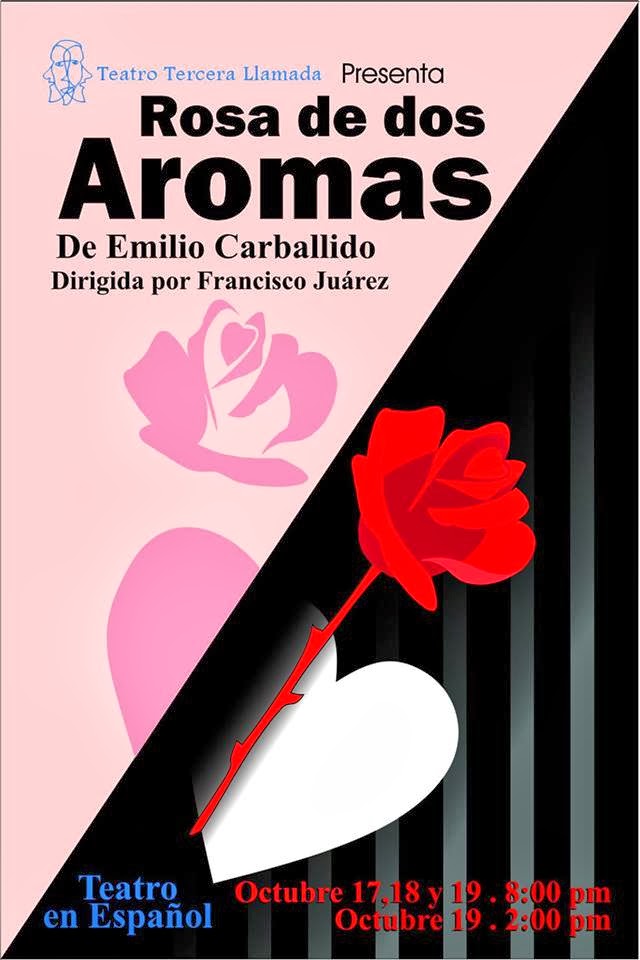
HC:  We plan to do two plays a year, and one of those is Rosa De Dos Aromas (A Rose of Two Scents) by Emilio Carballido. It has been the most produced play in Mexico. And then we have Almacenados (Warehouse) by David Desola. He’s a playwright from Barcelona who is really picking up steam. Almacenados is playing now in Mexico City and also ran in Paraguay. We’re the first company in the United States to do it. 

RW:  Can you tell us a bit about the plays?
HC:  They are both comedies. Rosa De Dos Aroma is about two women: one of them is a sophisticated university graduate; the other one is a hair stylist. They meet in the lobby of a prison. Amalcenados is about two Cubans: one is a playwright; and the other is an actor. One is old and one is young, and they work in a warehouse. That’s what is planned for the first half of next year. We’re still up in the air about next fall. But we have plenty of time. 

RW:  Do you often perform authors who are well known?
HC:  Whatever the director wants to do. The rule is if you want to direct one, then you pick your own play and we’ll support you.

RW:  Have you gotten a good audience response so far? 
HC:  Absolutely. Thursdays are not filled up, but Fridays are usually full houses.

RW:  Has the response surprised you?
HC:  I met a girl at World Fest, from Honduras, who recognized me from the show and she wasn’t the only one. I wasn’t expecting that. I just want to do theater because I love the storytelling and I love to exercise my mind. Carlos put my picture up on our webpage page. I said, “Take that down.” He said, “Get used to the fame.” 


Rosa De Dos Aromas por Emilio Carbadillo runs October 17-19
Almacenados por David Desola runs October 24-25

Teatro Tercera Llamada
at The Baron’s Theater
131 West Main Street
Louisville, KY 40202

Tuesday, October 1, 2013

A Quick and Immensely Enjoyable Look at Kentucky's Culinary Past with "The Historic Kentucky Kitchen"


The Historic Kentucky Kitchen (Traditional Recipes for Today's Cook)
by Deirdre A. Scaggs and Andrew W. McGraw
University Press of Kentucky
Paperback, $29.95

Review by Chef Madeleine Dee

Entire contents are copyright © 2013, Madeleine Dee. All rights reserved.

When I was very young, I discovered an exhibit at a museum where I could dig up a dinosaur like a paleontologist. I stayed right there, covering the bones with dirt and brushing them back into view over and over again for a couple of hours until my parents insisted that I go and look at some other parts of the museum. From that point on, I was completely hooked on history and I planned to be an archaeologist until I got to college. I am now a chef, actress,and writer, but I still fantasize often about uncovering the past for a living. So I was over the moon when I was asked to review a cookbook about Kentucky's food history.

The Historic Kentucky Kitchen by Deirdre A. Scaggs and Andrew W. McGraw is a tiny book – it has only 163 pages (Notes, Resources and Index included). However, it is absolutely packed with interesting facts, tips and photographs that bring the recipes inside to life and connect the written instructions with the Kentuckians who prepared these meals between the 1870s and the 1960s. The recipes as originally written could be quite confusing to modern cooks, but the authors made sure to adapt each one so that everyone today can prepare the dishes with ease. They even included a couple of pages documenting substitutions for items like outdated fats, conversions for modern ovens, and measurements like "Butter the size of a walnut," which is roughly 2 tablespoons. These pages were a great addition for bringing this cookbook into modern times.

The historical context is absolutely fascinating. One quote that resonated with me was the very first sentence: "Cookbooks and their recipes are important and historically revealing, because in addition to techniques of food preparation, they give us an understanding of people's lives." This statement began the Foreword by John van Willigen, the Professor Emeritus of Anthropology at the University of Kentucky, and I think his words are spot on. Leafing through the pages of this book gave me a genuine sense of how life was for Kentuckians many years ago – slower, more simple, much more focused on the preparation of local, organic meals. Food was something that was made by hand and was shared with loved ones. He also mentions that "handwritten recipes can be a link with the past." I agree – handwriting is very personal and gives you a sense of what mattered to the writer.

The inspiration for this cookbook was the discovery of an unnamed recipe from Logan English that included zucchini, tomatoes, anchovies and eggs. It was apparently so delicious that it started an adventure for the two authors, who set out to discover other "receipts" (an old time word for recipes) in UK's collection of archived recipes from the 19th and 20th Centuries. They focused on handwritten recipes because they "seemed more cherished, more likely to have been used to prepare food in Kentucky homes" and appeared to be "more traditional and authentic."

Some of the most prominent recipe contributors were Lucy Hayes Breckinridge, Frances Jewell McVey and Louise Ludlow Dudley. There were 12 other individuals and families listed in the recipe titles. I found it interesting that these recipes were some of the only documentation of their lives. I was really impressed by Lucy Hayes Breckinridge having 25 recipes in this book, and I wanted to know more about her. But a Google search turned up absolutely nothing other than the names of some of her family members, the dates of her birth and death, and a strange quote about her from a relative. I wish I could know more about her life, but I think it's very cool that her culinary knowledge will live on in The Historic Kentucky Kitchen, even if very little else about her is documented.

This book has eight sections of recipes: “Eggs and Cheese Dishes,” “Biscuits and Breads,” “Sides,” “Soups and Stews,” “Main Courses,” “Desserts,” “Beverages” andAccompaniments.” Flavor influences for the dishes range between African, French, English, American and Southern, which makes for an interesting variety. In the back, the resources are listed and there is some information about the recipe writers/collectors. I would only recommend the “Desserts” section to experienced bakers, because you need to know what you're doing in order to follow the sometimes odd instructions. “Beverages” was fascinating with recipes for things like Blackberry Vinegar, Ginger Tea and Porter Soda. Pickles, Ginger Nuts and Strawberry Syrup were items that caught my eye in the “Accompaniments” section. A couple of recipes that made me giggle were for Coffee and for Boiled Cauliflower. No two things could seem simpler, but I bet the results are just right!

My only personal issue with this cookbook is that many of the recipes use dairy products liberally, and I am lactose intolerant. Most people are not, so this book is a great choice for the majority of cooks and eaters; but I don't recommend it for people like myself who have problems with milk, cream and other dairy products. I thought a lot of dishes sounded great, but I wouldn't have been able to enjoy them.

I did prepare a dish: Logan English's Chicken! It was delightful and turned out perfectly. The taste was really unique and I enjoyed it immensely. Keeper! Other recipes that I can't wait to try: Cheese Souffle, Frances Jewell McVey's Coffee Cake, Lucy Hayes Breckinridge's Corn Soup, Nannie Clay McDowell's Burgoo, Louise Ludlow Dudley's Fried Chicken... I pretty much want to make everything!

All in all, I would highly recommend this cookbook. I really loved the old black-and-white photographs scattered throughout the pages, and I especially enjoyed the descriptions and notes about each section and about each recipe. I read this cookbook like it was a novel and learned a surprising amount about Kentucky's culinary history. The recipes and notes effectively transport you to another time when making meals by hand and sharing them with others was an everyday thing, quite unlike the eating habits of most folks here in 2013. I often wish that I had the time to prepare big meals for my loved ones on a regular basis. Perhaps with the help of this book, I'll take a day or two off from work every now and then so I can do just that.

http://thehistorickentuckykitchen.wordpress.com/featured-recipes/